
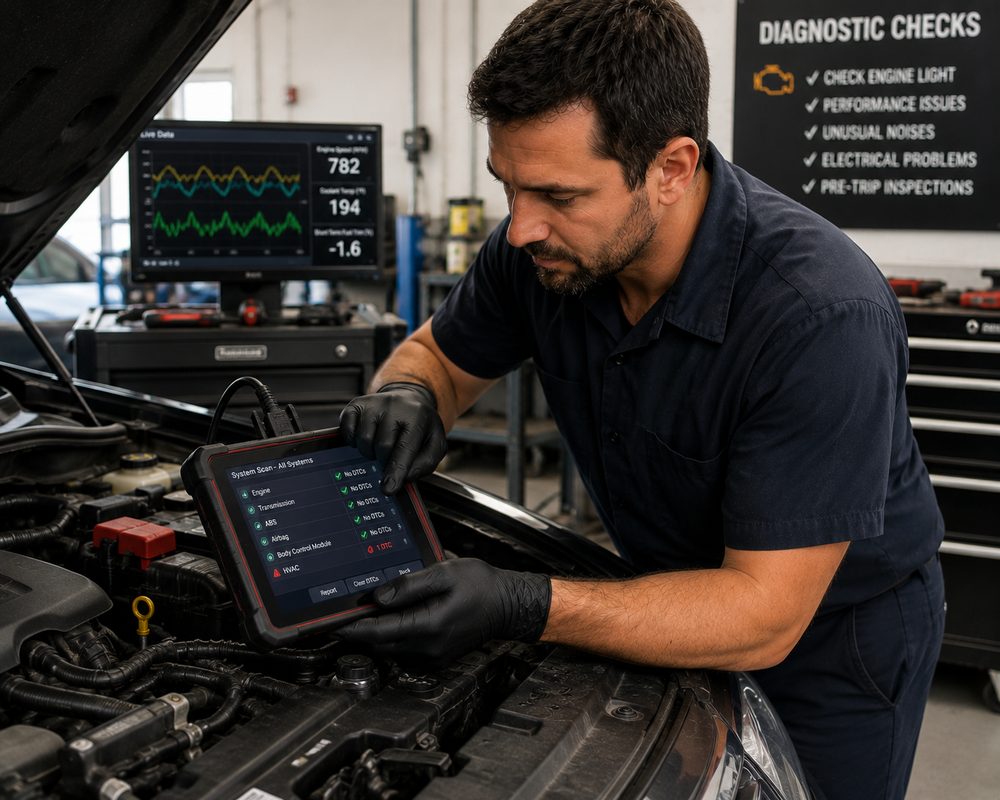
Few things spike your blood pressure like a check-engine light popping on during your morning commute. The frustrating part is how vague it is — the same amber glow can mean "tighten your gas cap" or "your catalytic converter is on its way out." The light itself doesn't tell you which. What it does do is store a trouble code, and that code is where the real answer lives.
First, is it steady or flashing?
This is the one distinction every driver should know:
- Steady light — the car has logged a fault that needs attention, but it's usually safe to keep driving carefully and get it scanned soon.
- Flashing light — this means an active engine misfire that can dump raw fuel into and destroy your catalytic converter (an expensive part). Ease off the gas and get it checked right away. If it's flashing, don't "wait and see."
How the code actually gets read
Every car since 1996 has an OBD-II port — usually under the dash on the driver's side. A scan tool plugs in and pulls the stored code, something like "P0301" or "P0420." That code narrows down the system and often the exact cylinder or sensor involved. Here's the important nuance: a code points to where the problem is showing up, not always the root cause. "P0420 — catalyst efficiency low" might be a bad converter, or it might be a failing oxygen sensor upstream fooling the computer. Reading the code is step one; diagnosing it correctly is the real work, and it's where a good tech earns their keep.
The usual suspects
A handful of causes account for most check-engine lights we see:
- Loose or worn gas cap — genuinely one of the most common triggers. A bad seal lets fuel vapor escape and sets an evaporative-system code. Tighten it; if that was it, the light may clear itself after a few drives.
- Oxygen (O2) sensor — worn sensors throw off the fuel mixture and hurt your gas mileage.
- Spark plugs or coils — worn ones cause misfires (that flashing light and a rough idle).
- Mass airflow sensor — meters incoming air; when it's dirty or failing the engine runs poorly.
- Catalytic converter — the expensive one, and often the downstream victim of ignoring the cheaper problems above.
The gas-cap trick
Before you panic, pull over when it's safe and check that your gas cap clicks tight. It's free, it takes ten seconds, and it's the fix often enough that it's always worth ruling out first.
The bottom line: a steady light means get it scanned soon; a flashing light means get it looked at now. And never let a shop replace a part just because a code has that part's name on it — good diagnosis confirms the cause first.
Why not just ignore it?
Plenty of people drive for months with the light on, and sometimes nothing dramatic happens. The risk is that a small, cheap problem quietly becomes a big, expensive one — a misfire chewing up a converter, a bad sensor burning extra fuel every day, or a real failure hiding behind the same light you've learned to tune out. A quick scan turns "I don't know" into a clear, honest answer.
When to just call us
Bring it by and we'll pull the codes, tell you in plain English what they mean, and — this is the part that matters — actually diagnose the cause before we recommend a single part. Sometimes the news is "it's just your gas cap, you're fine." Sometimes it's more. Either way, you'll get the straight story and a fair price. That's the whole idea behind two dads doing the work.